Section title
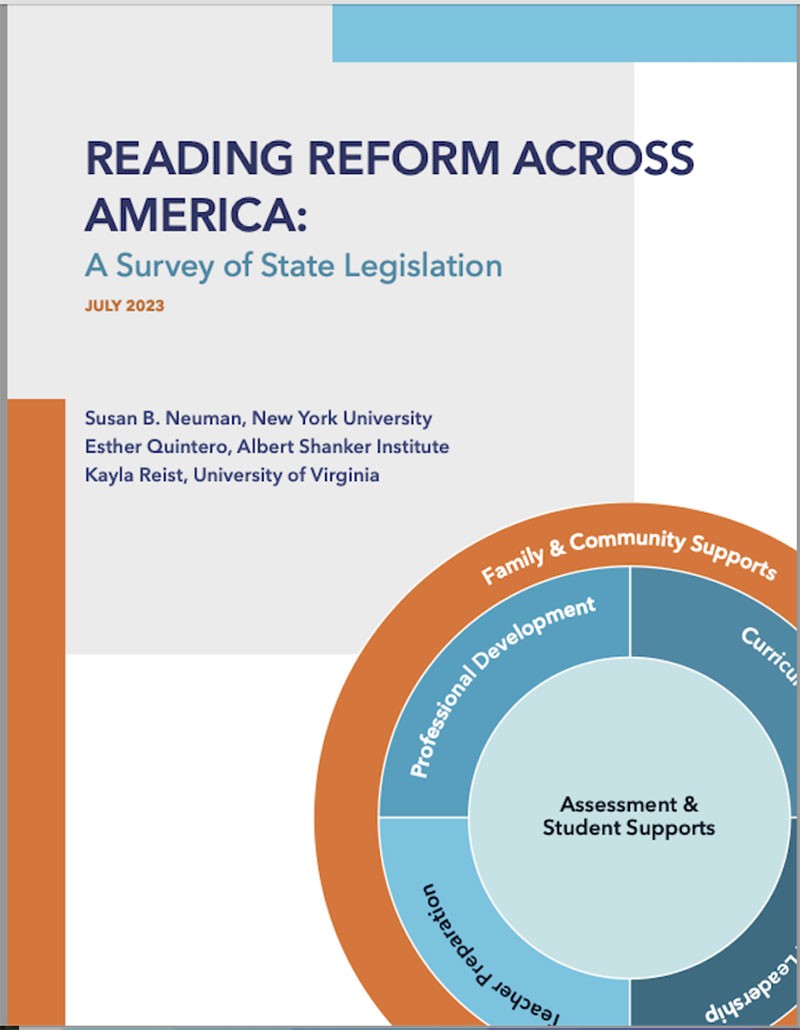
Reading Reform Across America: A Survey of State Legislation
July 2023
Susan B. Neuman, Esther Quintero, and Kayla Reist
In recent years, a scientific approach to reading education has gained traction due to the joint efforts of educators, parents, and state leaders. This movement for better reading instruction has helped to fuel a wave of legislation to address persistent reading deficits of American students. While reading difficulties cut across socioeconomic lines, they disproportionately impact students living in poverty as well as those from black, brown, and indigenous communities.
Reading Reform Across America documents how state legislatures nationwide have responded to these challenges. Specifically, the report examines reading-related legislation enacted between 2019 and 2022. We analyzed a total of 223 bills enacted in 45 states and the District of Columbia examining over 40 features, such as the pillars of reading, teacher preparation, professional development, curriculum, and student supports to name a few.
The Urgency — and Opportunity — of Effective Literacy Instruction for All: Multilingual Learners in Literacy Legislation
July 2026 (expected)
Claude N. Goldenberg, Esther Quintero, and Susan B. Neuman
As states continue to enact ambitious literacy legislation, a common assumption underlies many reforms: that strong literacy instruction benefits all learners, including multilingual learners. While this premise is largely correct, leaving multilingual learners’ specific instructional needs implicit represents a missed opportunity. Attention to multilingual learners often brings core dimensions of reading development—such as oral language—into sharper focus, strengthening literacy policy for all students rather than diverting from general reform.
This upcoming report examines how multilingual learners are addressed in state literacy legislation, analyzing what is made explicit, what is assumed, and where guidance is absent. It assesses whether current reforms support multilingual learners within coherent literacy systems that build on shared foundations while specifying what multilingual learners uniquely require. Drawing on legislative analysis and research, the report offers recommendations to strengthen literacy policy for all students and outlines what a next generation of literacy legislation might look like—one that prioritizes coherence over fragmentation to avoid uneven progress.