
Over the years I've strongly supported the federal government's role in gathering and circulating educational data because we can't make intelligent decisions without knowing how public education is doing. But getting adequate funding for data collection and research hasn't been easy. The Congress has been suspicious that this Administration, in particular, was more interested in cooking the facts to fit its ideology than in doing objective research, especially on the subject of education spending.
Proof that such suspicions are justified comes from a graph prepared by the Ed Department's Center for Education Statistics and distributed by a high Department official at a conference earlier this year. The handout tries to convince us that from 1963 to 1988 there was a direct connection between the rise in elementary and secondary school spending and the decline in SAT scores. It's the old Administration message: money doesn't improve education and may even make things worse!
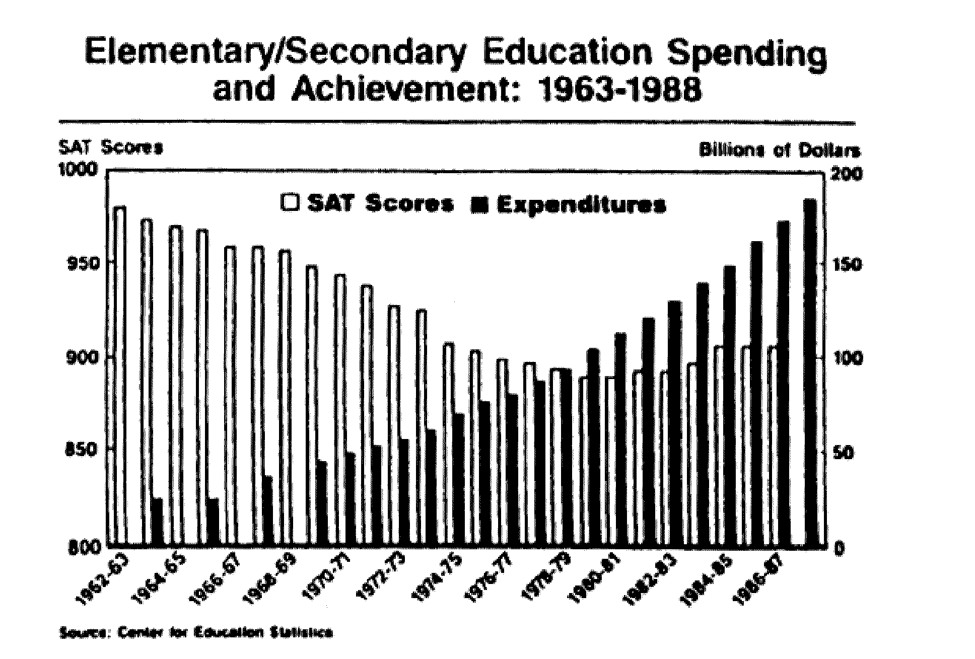
What's wrong with this picture? In the July 1988 issue of ETS Policy Notes, Dr. Joan Baratz Snowden, Director of the Policy Information Center of the Education Testing Service, provides the answer: "The graph is as inaccurate as it is dramatic." First, to get the sharp rise in education spending, Baratz Snowden points out, the Ed Department used current dollars rather than constant dollars adjusted for inflation. A more accurate graph done by ETS shows that with inflation figured in "expenditures have barely risen during the last 20 years."
Second, although SAT scores have gone down, the Ed Department graph vastly exaggerated the decline. Baratz-Snowden shows us how. SAT scores go from 400-1600, but the graph uses an 800-1000 scale. Presto! A more severe decline than an accurate graph would show. The Department also doesn't bother to tell us that the students who take the exam don't represent a random sample of our student population. It used to be that only the best students were encouraged to take the SAT. Now the test-takers are more numerous and diverse. The Department has compared apples and oranges, which is fruit salad, not research.
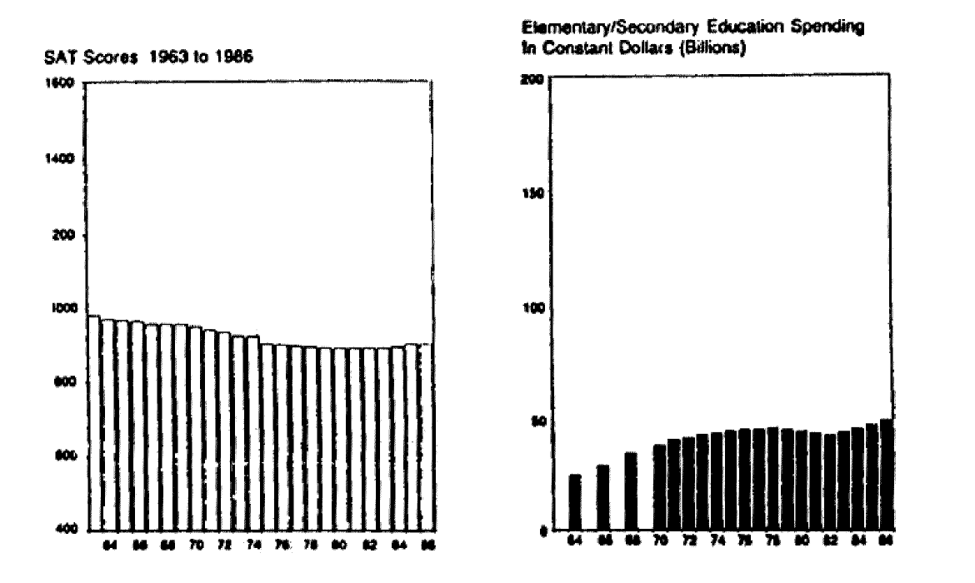
There are many positive developments in our school, Baratz-Snowden argues, that the Ed Department could have cited if it wanted to present the taxpayers with a more accurate picture of what they were getting for their money. But the idea that we might actually be getting a good return on our education investment has never really fit in with the Administration's ideology. The refrain repeatedly coming from the Ed Department has been that "money doesn't matter" - and worse: money hurts education. But parents know better. In affiuent districts, parents routinely opt for smaller classes, enrichment programs, up-to-date equipment, wellmaintained school plants and competitive teachers' salaries. As Baratz-Snowden says, "Money does matter."
The real issue is not whose opinion is right. This administration or any other is entitled to its opinion. But it's not entitled to abuse its authority by misrepresenting statistics to "prove" its opinion-at the taxpayers' expense. It's essential for the Ed Department to regain its credibility. As Joe Friday used to say, "The facts, ma'am; just the facts."