
Pay Equity In Higher Education
Blatant forms of discrimination against women in academia have diminished since the Equal Pay Act and Title IX became law in 1964 and 1972, respectively. Yet gender differences in salary, tenure status, and leadership roles still persist among men and women in higher education. In particular, wage differences among male and female professors have not been fully explained, even when productivity, teaching experience, institutional size and prestige, disciplinary fields, type of appointment, and family-related responsibilities are controlled for statistically (see here).
Scholars have argued that the “unexplained” gender wage gap is a function of less easily quantifiable (supply-type) factors, such as preferences and career aspirations, professional networks, etc. In fact, there is extensive evidence that both supply-side (e.g., career choices) and demand-side factors (e.g., employer discrimination) are shaped by broadly shared (often implicit) schemas about what men and women can and should do (a.k.a. descriptive and prescriptive gender stereotypes – see here)
Regardless of the causes, which are clearly complex and multi-faceted, the fact remains that the salary advantage held by male faculty over female faculty exists across institutions and has changed very little over the past twenty-five years (see here). How big is this gap, exactly?
I compiled and analyzed faculty salary data found on the American Association of University Professors (AAUP) website – the AAUP Faculty Salary Survey. Specifically, I looked at the past four years of salary information for professors, associate professors, and assistant professors employed at doctoral degree granting institutions (n=224).*
The graph below presents the percent difference between male and female salaries between 2008 and 2011 (note that the vertical axis begins at five percent).
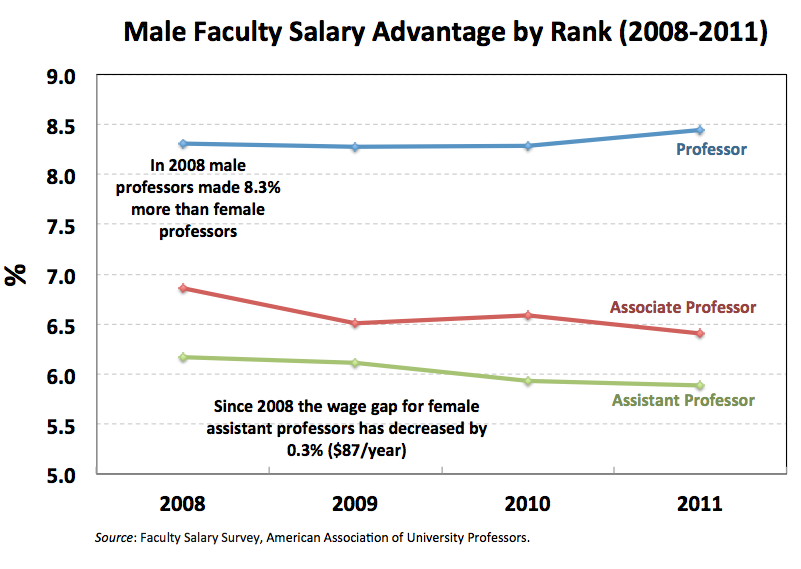
The first thing to note is that the three lines are relatively flat. This is also the case for wage inequalities in other occupations, which is why scholars refer to the gender revolution as being “stalled and uneven” – see here.
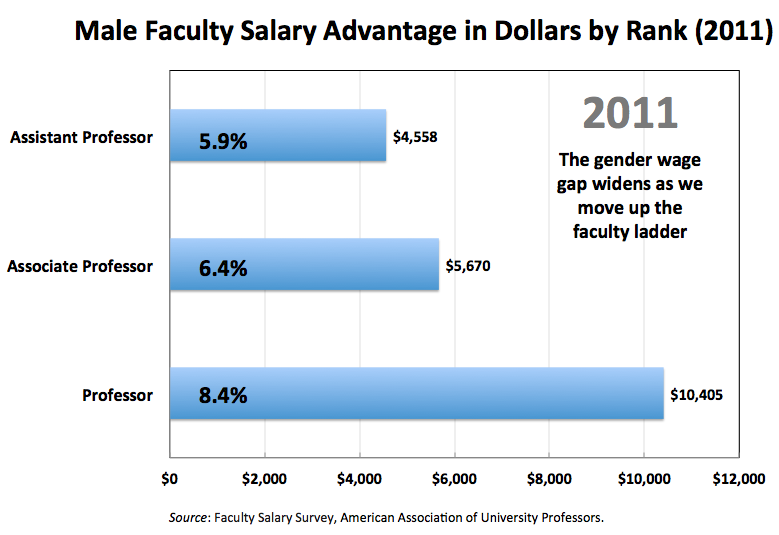
Second, we see that the wage gap between men and women is largest at the rank of professor and smallest at the rank of assistant professor. As the graph below illustrates, in 2011, male professors made, on average, 8.4 percent more per year ($10,405/year) than their female counterparts. As for men in the associate and assistant professor ranks, they made, respectively, 6.4 percent and 5.9 percent more than women in the same positions.
Of course, as mentioned above, a portion of the gap in earnings may be due to unobserved differences between male and female professors – most notably, the concentration of men in higher-paying fields such as engineering and science. Also, the above data are only for the past four (recession) years. Nevertheless, while part of the gap “disappears” when multiple factors in addition to gender are taken into account, it is also the case that important differences in earnings do remain unexplained.
We tend to think of colleges and universities as meritocratic institutions. So here, of all workplaces, continued self-reflection and rigorous research are in order.
- Esther Quintero
*****
* The rank of instructor was omitted from the analysis due to missing data. Our sample includes institutions for which there was two or more years of salary data. Institutions with only one year of data were excluded from this analysis.
First, assuming academics are a good example of a meritocracy is charming - in the same way multicolored unicorns are charming.
But the bigger point is that you do not account in any way for the gender and pay differences between disciplines. There are probably many more men in engineering (or even business) departments working at higher pay than say, history, that might have an even distribution of men and women, but overall lower average pay. If this bias is not accounted for, the results of your analysis are weakened. I know you mention this problem but you do not provide any numbers that indicate how strong this factor is in your data. You claim it is relatively small, but my intuition tells me otherwise. We need these numbers to take your work as a meaningful measure of gender bias.
Rick,
I make the exact same point. Unfortunately the AAUP data that are publicly available do not permit a more nuanced examination.
I make no claims about the size of the effect - I can't with these data anyways. When I say "important differences in earnings" I am referring to the existing literature on this issue. I also think they are important simply because, over the course of a lifetime, even small differences accumulate.
I am most interested in the mechanisms that explain both occupational segregation and the gender wage gap – i.e., the social psychological literature on gender stereotypes.
Thank you for your comment.
If you are making the same point as I, then I am not sure the point of your piece. I am saying the data is meaningless as analyzed, yet you use the data to infer. It is impossible to compare salaries outside departments. The big factor is starting salary level - quite different when comparing English and Chemical Engineering. And then many other factors create large differences - not the least is the effectiveness of the department chair or college dean in negotiating with the upper administration. And then there is favoritism, artificial measures of productivity, perception, PR and of course, residual sexism and racism. It will take some serious work to unravel details.