
The Accountability Gap: D.C. Schools and Students with Disabilities
When I first moved to D.C., it took me some time to get used to the school system. Multiple city agencies share oversight of public schools, and enrollment is split nearly evenly between traditional public and charter schools— making finding a teaching job strenuous (lots of separate fingerprint appointments!). It wasn’t until I was in the classroom that I grasped how exhausting this fragmented system is for families. Witnessing the difficulty of transitioning from a public to a charter school was one of many consequences of this fragmentation. One of my parents moved to an online charter school because she was told her family would get more targeted support, only to realize that she had to quit her job to monitor her child’s lessons adequately due to her child’s ADHD.
In December 2024, the U.S. Department of Education’s Office for Civil Rights (OCR) confirmed these challenges by releasing a report from their investigation on DCPS for discrimination of students with disabilities (SWD). In this report, the Commission highlighted two findings of discrimination: DCPS relies on due process complaints to deal with injustice, and they fail to provide transportation services for SWD that require it.
These observations contribute to a larger pattern of fragmented governance for marginalized students. The District of Columbia's education governance system is structurally fragmented in ways that obscure accountability and prevent meaningful community participation. Because D.C. functions simultaneously as a city and a state, its education agencies operate across overlapping and competing jurisdictions with no single body held democratically accountable for outcomes. This fragmentation did not flourish on its own; policy actors have prioritized market-based ideologies that treat parents like consumers in a free market. As a result of this neoliberal model, families in need are left with improper access to school resources and civic engagement. Both community and researcher voices agree that D.C.’s governance system requires structural reform to enforce democratic accountability and promote equitable access to high quality public and charter schools to all students.
D.C’s Unique Governance Structure
In the District, public education is delivered through two sectors: DC Public Schools (DCPS), which operates as a single traditional public school LEA, and the public charter sector, which spans 133 schools overseen by the DC Public Charter School Board (DC PCSB). Charter schools have shown consistent enrollment growth in all of D.C., but particularly in wards 5 and 8 with a 50% enrollment increase between 2011 and 2015. The highest number of charter schools are located in Wards 5, 7, and 8, which also hold the highest population of marginalized families. 92% and 90% of D.C. residents are black in Ward 7 and Ward 8 respectively, which nearly doubles the city’s 43% average. Similarly, 26.6% and 35.7% of residents in Wards 7 and 8 are in poverty, which is considerably higher than the city’s average of 17.3%.
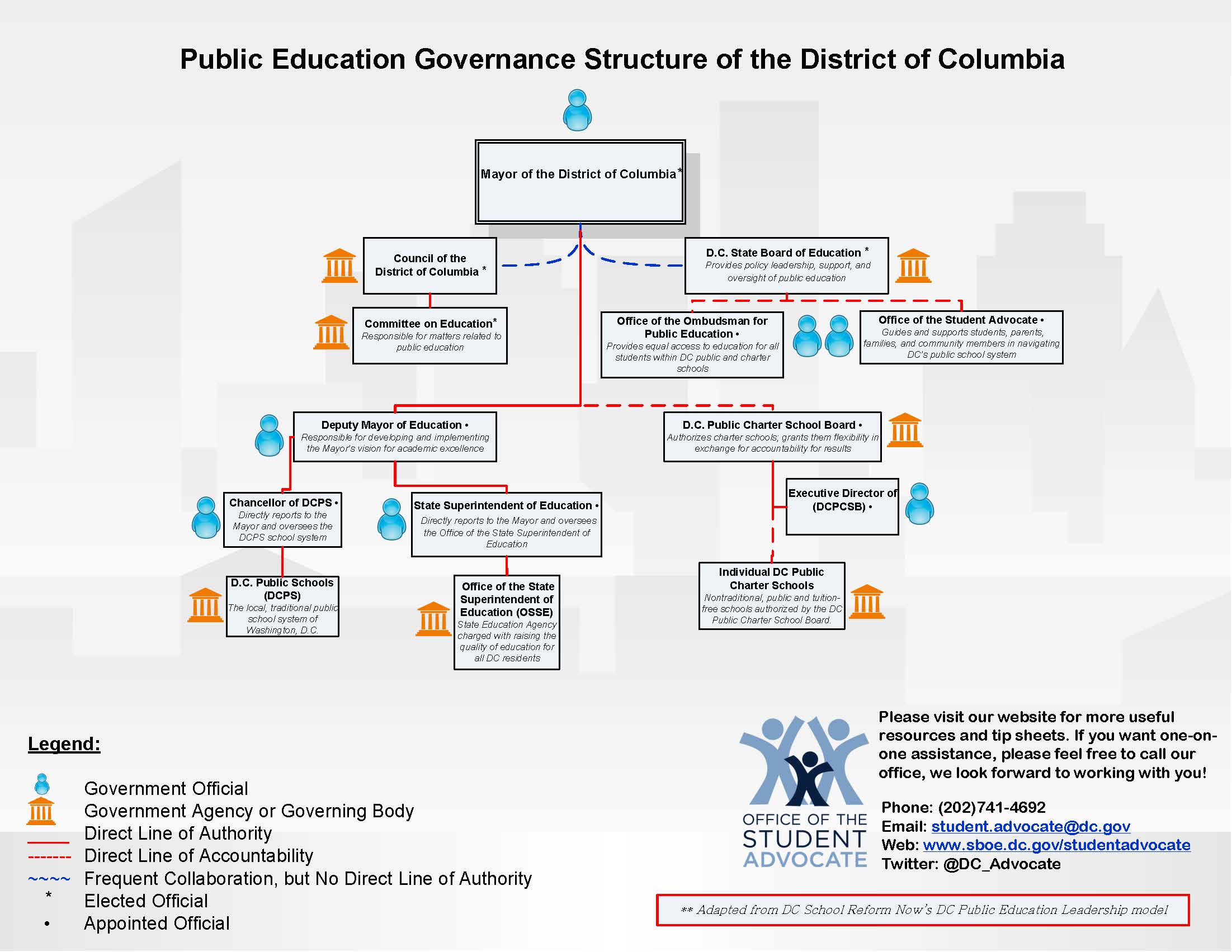
The District’s governance system is complex, with many agencies overlapping to support public schools. Figure 1 represents the governance structure through a top to bottom flow chart, provided by the Office of the Student Advocate. The top authority held accountable for education is the Mayor of the District, currently Muriel Bowser. The blue lines represent collaboration but no direct line of authority to the D.C. Council and State Board of Education. The Council, and its Committee on Education, hold legislative authority over public education matters. The State Board of Education provides support and oversight but has no authority over the Mayor or Council. These governing bodies are both elected and thus held publicly accountable for education issues. The Office of the Student Advocate and the Ombudsman both support public and charter school students.
Moving down in public facing authority, the governance system splits to represent DCPS and the charter sector. These bodies are connected with red lines to the Mayor, whom they are accountable to. On the left side, DCPS is supported by the Chancellor, OSSE, and the Deputy Mayor of Education who executes the Mayor’s agenda. OSSE is responsible for “raising the quality of education for all D.C. residents”, spanning to manage both public and charter schools. On the right side, DC PCSB and its Executive Director authorize charter schools and oversee their individual operations. All positions in the bottom half of the flow chart are appointed.
While DCPS and the charter sector both report to the Mayor, they operate through separate chains of authority with no direct line between them. OSSE and the Office of the Student Advocate serve as the only entities with formal reach across both sectors, making them critical public facing liaisons. The curriculum, teachers, and resource decisions are impacted significantly based on the sector a student is in.
Like other districts committed to a restructuring of low performing public schools, D.C. has functioned under mayoral control since 2007. The red lines in Figure 1 portray how the Mayor is in direct authority of all decisions regarding school compliance, performance, and policies. Mayoral control is often acclaimed for maintaining strong political accountability through elections. This accountability system is known as political accountability by scholars Loeb and Byun, as elected officials make decisions based on their constituents and are held accountable through re-election. However, many D.C. community members disagree, stating that mayoral control creates convoluted agencies that are inaccessible for parents who don’t know where to start when they have a problem.
The fact that D.C. functions as a city and a state further exacerbates the mayoral control aspect of governance. In all 50 states, the governor and mayor roles are held by separate elected officials: a mayor that answers to city services, and a governor that answers to statewide policy. But in D.C., the Mayor holds both roles. So, community members who want to challenge a state level education decision have no separate state political area to appeal to.
How Fragmentation Affects Students with Disabilities
Disruption within D.C.’s governance system also leads to ineffective accommodations for the public sector. In late 2024, the Department of Education’s Office of Civil Rights investigated DCPS for thousands of complaints that spoke to the district’s inability to adequately provide services for students with disabilities (SWD). The OCR Commission released their report with major findings of patterns of discrimination within the district, and a call to action for DCPS to take on recommendations or face further federal mandates.
The Commission highlighted that in D.C., there were 127 per 10,000 due process complaints filed against the national average of 33 per 10,000. This imbalance points to inequitable implications, as extensive time, money, and knowledge are prerequisites to filing a due process complaint. OCR also reported that OSSE fails to provide adequate transportation for SWD, with a multitude of complaints from parents that the district failed to notify them when the bus would be hours late or not show up at all. This left many parents to take on the responsibility of transporting their students themselves.
Put simply, the OCR investigation revealed that D.C.’s school systems place a huge responsibility on parents to ensure their students receive federally mandated services. The Commission agreed that market-based schools are designed to allow parents to choose their students best educational fit, while simultaneously placing the responsibility on parents to oversee school operations without institutional support.
Similar to this pattern, research on district school board politics reveals that fragmentation of governmental bodies can obfuscate public accessibility. D.C. is an example of what happens when decisions about schools are made by appointed officials who answer to the Mayor instead of families. In her book Navigating School Board Politics, Sampson argues for the integral role elected boards play in successful public education systems: "One of the biggest fallacies… is the idea that private and even public charter schools, which are governed by appointed boards, provide a better education than traditional public schools." D.C.'s appointed, fragmented chain of command leaves families with no clear democratic path to challenge decisions that directly affect their children.
Local advocates also scrutinized the lack of community voice and participation in public and charter sector decisions. During an interview with an active D.C. parent advocate, they stated that "one of the largest disconnects was parent education on knowing just how the system works... that parents were not fully versed in what due process looks like, what their rights were, what their children were entitled to." This parent perceived the system not only as inaccessible, but intentionally inhibiting community control. This confusion is echoed more broadly as well; parents navigating D.C.'s public education system have reported: "We don't know who these people are, what their roles are, and who we should reach out to when we have an issue." The many governance bodies that exist under, in between, and in collaboration with others creates confusion for parents on who to contact. Indeed, scholars Enoch-Stevens et al.agree in their article that treating parents as consumers inhibits parents' role in governance and accountability. In many ways, D.C. 's top down, convoluted governance system places an unfair burden on parents as the sole accountability arm with complicated legal matters such as advocating for their students with disabilities.
What Needs to Happen Next
It is evident that D.C.'s public school system needs structural reform: not just surface level fixes, but meaningful changes to governance, accountability, and community participation. Two reforms would shift D.C.'s approach from one that places the burden on families to one that provides institutional support. First, creating a unified SWD division within OSSE would consolidate oversight of special education services across public and charter schools, reducing families' reliance on due process and giving parents a clearer, more accessible channel for resolving accommodation concerns. Second, advocating for a community participation advisory board would formalize parent and teacher voices in charter authorization and expansion, addressing the democratic deficit that D.C.'s appointed governance structure has created. The burden to protect students with disabilities and hold schools accountable has fallen too heavily on parents. It is time for that burden to shift back to our institutions, and for those institutions to be genuinely accessible to the communities they serve.