When Teachers Teach Teachers, Teachers Learn

Our guest author is Kata Solow, executive director of the Goyen Foundation, where she led its multi-year transformation process and created the Goyen Literacy Fellowship to recognize exceptional reading teachers. 
Elementary school teachers across the country are asking for help. 

Go on Facebook, browse Twitter, and you’ll hear a common refrain: “We want to change how we teach reading, but we don’t know where to begin. We need to see what it looks like. Give us models and examples of excellent literacy instruction.” 

Why is this happening? For these teachers, their world has just changed. Over the last five years, as reading-related legislation has swept the country, hundreds of thousands of elementary school teachers are being required to change the way they teach reading. This is a really big deal: changing how you teach reading is a hard thing to do.

States are trying to help teachers make these changes. Most of the newly-passed laws support professional development for in-service teachers. However, the most common PD programs like LETRS are highly theoretical. While they provide educators with a strong foundation in the components of structured literacy and the research that underlies it, they do not address what these components look like in a real classroom.    

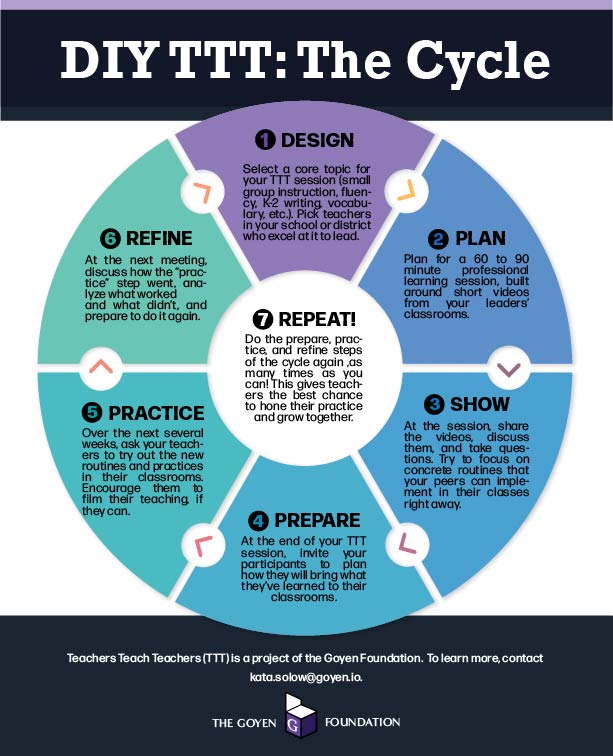
At the Goyen Foundation, we think that we have started to build a model that bridges this research-to-practice gap by providing teachers with concrete examples of great literacy instruction. This piece is about how you can do it in your school or district.   

Celebrating 20 Years of AFT Collaboration with PBS Public Television Station WETA on Colorín Colorado!

Guest author AFT Educational Issues Director Giselle Lundy-Ponce has been working in the field of PreK-12 education policy, research and advocacy for the last thirty-two years. In 2004 she initiated the partnership with the public television station WETA’s Learning Media Department to develop Colorín Colorado. Now with so much attention to the Congressional threat to defund public television, the story of 20 years of a successful partnership between AFT and public television station WETA -— to better meet the literacy needs of English language learners, their families, and their teachers -— is more important to tell than ever.

In 2005, the AFT announced that it was launching Colorín Colorado, an online resource hub, to provide educators of English language learners (ELLs) with evidence-based resources, best practices, and information to help their students read and succeed. At the time of the launch, we recorded 400 visitors to the site, and we were pleased because we were reassured that we were meeting a need. Fast forward to today, we are thrilled beyond words that the initial 400 visitors have grown to over 3.5 million. When Colorín Colorado was launched, it was limited: We were almost exclusively a PK-3 website focused on literacy instruction, and the target audience was primarily educators and families of Spanish-speaking ELLs.

Now we offer resources that span the PK-12 range, and the content of the website is applicable to ELLs from all language backgrounds. While many of the website’s resources are still available in Spanish, and we refer to the website as bilingual, we have added family literacy tip sheets in sixteen languages. Every year, we have kept growing and expanding beyond the literacy scope and are now the main clearinghouse for what works for ELLs in content areas across all academic subjects, social-emotional development, how to address trauma in the classroom, and a whole host of other topics on ELL instruction and ELL well-being.

Teacher Appreciation: The Center for Research on Expanding Educational Opportunity (CREEO) Connects Equity and Justice to Education Policy and Practice

Our guest author is Melika Jalili, program manager at the Center for Research on Expanding Educational Opportunity (CREEO), UC Berkeley.

Whether it is a focus on the teacher shortage, a discussion of our public schools, or Teacher Appreciation Week, it seems everyone agrees that teachers deserve more respect and recognition. Making that recognition meaningful, by supporting educators to be the teachers they have always dreamed they could be, should be a priority for all of us.

Cue in, Dr. Travis J. Bristol, Associate Professor at the UC Berkeley School of Education, who announced the exciting launch of the Center for Research on Expanding Educational Opportunity (CREEO) at UC Berkeley last month.

Rick Hess’ Uber Driver Speaks Out

Our guest author is Leo Casey, Shanker Institute executive director emeritus.

 I was out pounding the streets the other day, and a ride for Rick Hess at the American Enterprise Institute popped up on my driver’s app. Geez, I thought to myself, not him again. But I have to put food on the table and clothes on the back of my kids, so I headed over to AEI.

Ten minutes late, Rick jumps into my car, and starts in. “I want to ask you about…” I interrupted him: “Rick, before we get into what you want to talk about, I want to ask you a question first.”

From the Classroom to the Capitol: Teachers Can Make A Difference

Our guest authors José Luis Vilson and Dan Kliber are accomplished National Board Certified Teachers and activists.

The battle over the federal budget has dire consequences for schools across the country, particularly for those most in need of funding. Recently, some federal legislators have proposed extremely draconian cuts. The last education funding proposal from the U.S. House of Representatives would have slashed federal support for education by 30%, including an 80% reduction to Title I, which supports low-income schools. Had this proposal passed, public education as we know it could have been completely dismantled, putting over 200K teachers out of a job.

Reading Reform on the Ground: How SoR Policy is Showing Up in Schools

On International Literacy Day, we publish a guest post by educator, researcher, and author Callie Lowenstein who shares her incredible perspective of the in-depth thinking teachers offer to their practice and how sincerely teachers want to meet the needs of students.

One thing about teachers: we want to get our instruction right. 

After decades of mixed messages and misinformation in our professional development (PD), teacher training programs, and curricular materials, many classroom educators are eager to get on top of the science, to ensure that our efforts and hours, our lesson planning and detailed feedback and materials prep and book purchases and deep care for our students, are not being wasted. 

Indeed, after a major balanced-literacy leader published an unapologetic deflection of the science of reading movement last year, a group of teachers from across the country wrote our own open letter, collecting over 650 teacher signatures in a matter of days, attesting to the ways we, teachers, wished we had done better by our students.

As authors Susan B. Neuman, Esther Quintero, and Kayla Reist so expertly and carefully highlighted in the Shanker Institute’s Reading Reform Across America report, it’s not just us. 

Painting a Portrait of Professional Learning for the Science of Reading

Assumptions about homogeneity are baked into schools and schooling; grade levels are sorted by student age, classrooms by numbers of desks, and sets of standards specifying what to teach and when students will reach proficiency. While most people understand and would agree that students’ needs and rate of learning vary greatly, we seem to forget this when it comes to adult learning. Based upon this, we emphasize not all teachers need the same learning experiences and environments to develop expertise.

Teachers differ in the nature of their personal and professional experiences, in the assets and dispositions they bring to the job, in the role they play in their particular schools, and in their specific goals as educators. Thus, the professional learning opportunities available to them should not be one size fits all. This is easier said than done. Differentiating professional learning in any domain is complex, and reading is no exception. It is easier to book a speaker and order some materials than it is to design opportunities for professional learning that meet each educator where they are. Yet, for Science of Reading (SOR) based reforms to be implemented in ways that make a difference for students, coherent, contextualized, and engaging professional development on the SOR is crucial.  

As a wave of reading reform, legislation related to the SOR represents an attempt to focus instruction on the explicit teaching of foundational skills, based on research that affirms the importance of phonemic awareness and phonics in beginning reading. Many SOR reforms aim to boost the knowledge and skills of individual teachers, with less attention to the ecosystem of schooling where these teachers are embedded, or to how leaders and teachers collaborate to improve instruction. SOR reforms often mandate that districts adopt new curricula and teachers teach with these materials. But implementing SoR reforms is complex, as it simultaneously involves individual learning and organizational change. Therefore, as we have described here, here, and in this podcast, it is crucial to align professional development, curriculum, and leadership – the three pillars of the reading infrastructure. These pillars enable instructional improvement by creating organizational conditions for systemic change. In this post, we concentrate on the professional development pillar.  

Co-Teaching For Emerging Bilingual Learners: Theory And Practice

Co-teaching is an education buzzword frequently used in the context of instruction for students with special needs or English Language Learners (ELLs). When implemented thoughtfully and intentionally, co-teaching can be highly effective at meeting the unique needs of all learners. In this post, I will focus on co-teaching for English Language Learners, to whom I will refer to as “Emerging Bilingual Learners (EBLs), a more accurate label that highlights the assets these learners bring to the classroom. 

My argument, which is supported by research and my own professional experience, is that co-teaching is a particularly effective method for EBLs when one teacher is trained to meet the language needs of EBLs (and all learners) and the other focuses on grade level standards. Using co-teaching models, language is not the end goal, but rather a vehicle that enables EBLs to gain understanding of grade level content. The focus is not solely on the language that students are developing but rather on the academic content all students must acquire. This is important because it does not stigmatize students and it levels the playing field for each learner.

Not only does this inclusive model of teaching focus on the assets of every child, but it provides a more diverse learning environment while building trusting relationships amongst students' peers and teachers. The co-teaching model can be instrumental to fostering a greater sense of community within the classroom. Gloria Ladson-Billings (1995) stresses the importance of instilling community pride into a classroom, where teachers and students have a reciprocal autonomous relationship. EBLs need to feel a deep sense of belonging in order to be willing to take risks and make mistakes.

What's Next For Schools After Coronavirus? Here Are 5 Big Issues And Opportunities

This is post is our first in a new blog series entitled Teaching and Learning During a Pandemic, in which we invite guest authors to reflect on the challenges of the Coronavirus pandemic for teaching and learning. Our contributor today is Andy Hargreaves who is Research Professor at Boston College. This blog post originally appeared in The Conversation. Future posts in the series will be compiled here

No schools, no exams, more online learning and parents in COVID-19 lockdown with their kids. What a mess!

People are responding heroically. Some parents are working from home, others have lost their jobs and teachers are creating an entire new way of doing their jobs — not to mention the kids themselves, stuck inside without their friends. Somehow, we will get through this. When we do, how will things look when school starts again? 

One of my university projects connects and supports the education leaders of six countries and two Canadian provinces to advance humanitarian values, including in their responses to COVID-19

From communication with these leaders, and drawing on my project team’s expertise in educational leadership and large-scale change, here are five big and lasting issues and opportunities that we anticipate will surface once school starts again.

Quality Teaching Needs Quality Support

Our guest authors today are Ulana Ainsworth, a special education teacher at Curtis Guild Elementary School in Boston, MA and Jodie Olivo, a fifth grade teacher at Nathanael Greene Elementary School in Pawtucket, RI.

Among the most underserved populations in education are teachers themselves. Until now, most applications of technology in the schools have focused on students. Student access is critical, but leaving out the most critical person in the room –the teacher –is a huge mistake. Working with the American Federation of Teachers (AFT) and other education leaders, IBM committed to changing that this fall with the launch of Teacher Advisor With Watson, a totally free online tool that uses IBM’s innovative artificial intelligence technology. IBM’s Teacher Advisor enables teachers to deepen their knowledge of key math concepts, access high-quality vetted math lessons and acclaimed teaching strategies, along with annotated video all integrated together, giving teachers the unique ability to tailor those lessons to meet their individual classroom needs.

IBM technologists worked directly with teachers and other education experts over a two-year period to develop this new tool. TeacherAdvisor.org will help strengthen teachers’ ability to instruct students with varying degrees of preparation in elementary school math – the gateway to learning more complex concepts. The technology has been trained by some of the nation’s leading math experts. And with more training and teacher more use by teachers, Teacher Advisor will continue to learn and improve.