Efforts to help strengthen and improve public education are central to the Albert Shanker Institute’s mission. This work is pursued by promoting discussions, supporting publications and sponsoring research on new and workable approaches to ensuring that all public schools are good schools. As explained by Al Shanker below, these efforts are grounded in the belief that a vibrant public school system is crucial to the health and survival of the nation:
"...I believe that public education is the glue that has held this country together. Critics now say that the common school never really existed, that it’s time to abandon this ideal in favor of schools that are designed to appeal to groups based on ethnicity, race, religion, class, or common interests of various kinds. But schools like these would foster divisions in our society; they would be like setting a time bomb.
"A Martian who happened to be visiting Earth soon after the United States was founded would not have given this country much chance of surviving. He would have predicted that this new nation, whose inhabitants were of different races, who spoke different languages, and who followed different religions, wouldn’t remain one nation for long. They would end up fighting and killing each other. Then, what was left of each group would set up its own country, just as has happened many other times and in many other places. But that didn’t happen. Instead, we became a wealthy and powerful nation—the freest the world has ever known. Millions of people from around the world have risked their lives to come here, and they continue to do so today.
"Public schools played a big role in holding our nation together. They brought together children of different races, languages, religions and cultures and gave them a common language and a sense of common purpose. We have not outgrown our need for this; far from it. Today, Americans come from more different countries and speak more different languages than ever before. Whenever the problems connected with school reform seem especially tough, I think about this. I think about what public education gave me—a kid who couldn’t even speak English when I entered first grade. I think about what it has given me and can give to countless numbers of other kids like me. And I know that keeping public education together is worth whatever effort it takes."
Albert Shanker, 1997
-
-
Citizen Power Challenge Grant Winners
Classroom projects such as learning about global cultural perspectives as a way to build compassion, planning a community garden to promote healthy eating, combating bullying, learning American Sign Language and building a health and wellness library are some of the 15 winning projects in the Citizen Power Challenge. The challenge, funded by the Aspen Institute’s Pluribus Project, is sponsored by the American Federation of Teachers, the Albert Shanker Institute and First Book. More information and list of winners.
-
2016-2017 Conversations
List of the 2016-2017 Conversations. Please note that due to the election, the first Conversation will be held the third Wednesday in November. There will be no December Conversation. The Conversations will resume in January, February, March, April and May. -
Reclaiming the Promise of Public Education Conversation Series
Sponsored by the Albert Shanker Insitute and the American Federation of Teachers, this monthly conversation series is designed to engender lively and informative discussions on important educational issues. We invite speakers with diverse perspectives, including views other than those of the Albert Shanker Institute and the American Federation of Teachers. What is important is that these participants are committed to genuine engagement with each other. Watch the past conversations and register for upcoming conversations. -
The Allocation of New Students to New York City High Schools
A research project documenting the characteristics and assignment of students who enter New York City's high school choice process for the first time.
-
Let’s Talk: Professional Development Modules
The highest rate of vocabulary development (and corresponding acquisition of background knowledge) occurs during the preschool years. This makes preschool a crucial time for effective, content-rich instruction. Accordingly, the Institute has developed a series of Common Core State Standards (CCSS)-aligned modules, which are designed to strengthen the ability of early childhood educators to impart rich, academic content in fun, developmentally appropriate ways. The modules cover the academic domains of oral language development, early literacy, early science, and early mathematics.
-
CTE 2014: Career Training for the Knowledge Economy
This conference, sponsored by the New York Citywide CTE Advisory Council, the United Federation of Teachers, and the NYC Department of Education, with support from the CTE Technical Assistance Center of New York State, the American Federation of Teachers, the Albert Shanker Institute, and the Association for Career and Technical Education. was a special addition to the annual professional development day for New York City CTE teachers.
-
The Social Side of Education Reform
The Social Side is a lens that brings insight into a critical oversight in educational reform and its policies: Teaching and learning are not solo accomplishments but social endeavors -- they are best achieved, through trusting relationships and teamwork, instead of competition and individual prowess.
-
A Novel Approach To Understanding Teachers' Work & Work Context
The University of Wisconsin and the Albert Shanker Institute are jointly developing the Educator Day Reconstruction Method, which provides a new and flexible way of measuring teachers' work and the broader context where it unfolds. The Educator DRM can be adapted to meet a district's information needs and can be used to complement existing data sources. We view this customization process as something to be accomplished collaboratively, with districts and stakeholders.
-
The Good Schools Seminars
This seminar series is part of an effort to build a network of union leaders, district superintendents, and researchers to work collaboratively on improving public education through a focus on teaching. It emerges from the Albert Shanker Institute’s role as sponsor of provocative discussions about education and public policy reform.
Teaching in Context 10 Years Later: What It Means for Literacy Reform
This imortant panel discussion placed time as a central variable within the broader umbrella of social, organizational, and infrastructural conditions for instructional improvement, and asked what the past decade has taught us — and what it means for the literacy reform moment we are in.
AFT/SML/ASI Book Club with Skye Perryman
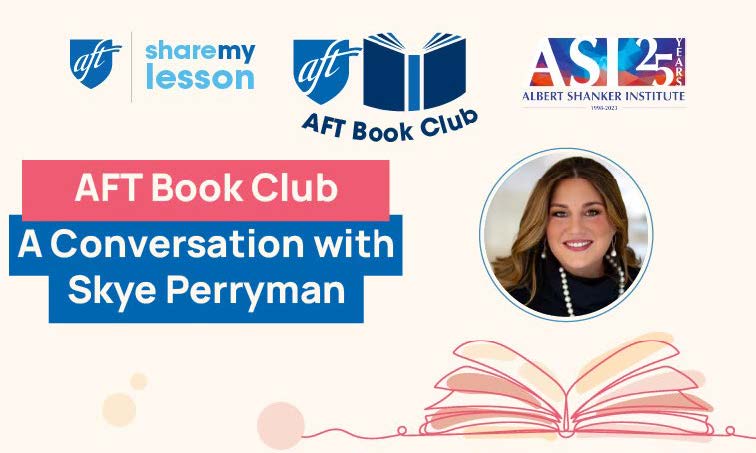
Skye Perryman joined AFT and ASI President Randi Weingarten for a timely AFT Book Club conversation. Perryman, a constitutional lawyer, TIME100 honoree and Democracy Forward President and CEO, discussed her new book, Ordinary People, Extraordinary Times: How to Reclaim Your Power, Fight for Freedom and Reimagine Democracy.
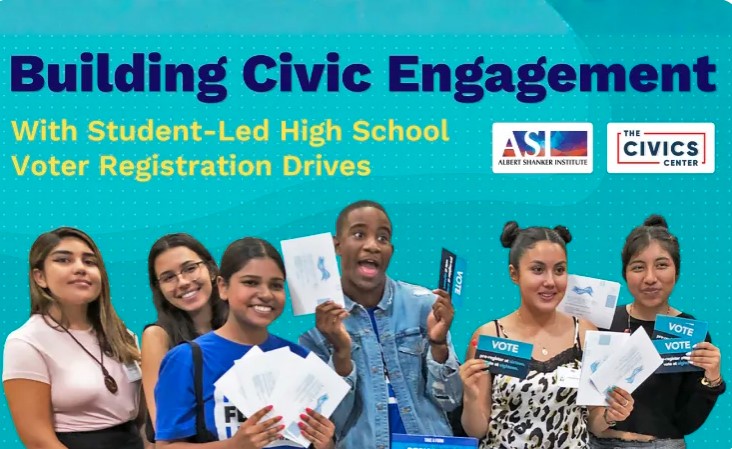
Building Civic Engagement Through Student-Led High School Voter Registration Drives
AFT/SML/ASI Book Club with Jonathan Kozol

For more than five decades, Kozol has challenged the nation to confront the deep inequalities in public education. In this urgent and deeply personal work, he returns to schools and communities across the country to examine the enduring realities of racial segregation, unequal resources and the barriers that continue to limit opportunity for many students.
AFT/SML/ASI Book Club A Conversation with Kamala Harris

AFT/SML/ASI Book Club with Dashka Slater

AFT President Randi Weingarten held a timely conversation with journalist Dashka Slater about her book, Accountable. Through the lens of a real incident at a California high school involving a racist social media account, Slater examines how students, educators and a community grappled with harm, responsibility, and the consequences of actions taken in online spaces.
High Quality After School Programming: What Does it Look Like and How to Get It
This webinar demystifies what high-quality after-school time programming looks like, empowers caregivers to advocate for access, and promotes accountability across after-school programs.
A Conversation with Jennifer Berkshire and Jack Schneider
Join us for our September AFT Book Club session featuring AFT President Randi Weingarten and distinguished authors Jennifer Berkshire and Jack Schneider, discussing their compelling new book The Education Wars: A Citizen's Guide and Defense Manual
A Conversation with Charles Blow and Randi Weingarten
Join us for our May AFT Book Club session featuring AFT President Randi Weingarten and renowned author Charles M. Blow, discussing Blow's memoir Fire Shut Up In My Bones. Engage with Weingarten and Blow as they explore the multifaceted themes reflecting on the complexities of identity, trauma and resilience within the backdrop of a segregated Louisiana town. Blow's ability to weave his personal narrative with broader social critiques makes the memoir a compelling read for anyone interested in the intersections of personal experience and public advocacy.
AFT Book Club: Conversation with Ruth Ben-Ghiat and Randi Weingarten
This groundbreaking new book club series is brought to you by the AFT, Share My Lesson and the Albert Shanker Institute. Tune in each month for an evening of inspiration, intellect and innovation—where the power of words takes center stage! Each month you will hear a fusion of words and wisdom as influential authors, scholars and activists engage in a riveting dialogue that promises to ignite your passion for literature and social change.
-
A Common Sense Approach to Demystify Universal Reading Screening with Multilingual Students
Our guest author is Lillian Durán, a professor in the Department of Special Education and Clinical Sciences at the University of Oregon. She develops language and literacy screening measures in English and Spanish and consults nationally regarding best practices in assessment with multilingual learners.
Children learn the languages they are exposed to across their daily lives, but children acquire the ability to read in a language through formal instruction. Awareness of this fundamental difference between language and literacy skill development is at the core of making common sense decisions regarding the screening of multilingual students for reading problems.
Universal Screening for reading development issues including dyslexia during the early elementary school years is now mandated or recommended in 49 states in the U.S. which naturally necessitates that all children are tested with the assumption that screening will accurately identify those children who will benefit from more targeted instructional support to reduce the likelihood that they will fall further behind in their reading development. The goal is to deliver effective and evidence-based reading intervention early that is likely to prevent reading failure before it becomes entrenched.
-
Proficiency or Penalty? Grade Retention Policy and Its Implications for English Learners in Utah
One common goal of public education is to ensure all students reach academic mastery. In fact, most U.S. states have agreed upon a set of aligned standards of mastery through the Common Core. To that end, it may make sense to lawmakers that students repeat third grade and get another ‘at bat’ if they weren’t able to reach reading proficiency. This theory of change— accountability in action— has prompted many states to reinforce their literacy legislation with retention provisions. Eighteen states, including the District of Columbia, require grade retention for nonproficient third graders with varying good cause exemptions. Oklahoma and Utah both added retention requirements in their 2026 literacy legislation. Our study seeks to determine whether the theory of change used by lawmakers aligns with existing research on grade retention.
In the aftermath of burgeoning grade retention policies, scholars and stakeholders are questioning whether retention will improve outcomes, or if it will become another reform that unintentionally punishes marginalized families. By interviewing stakeholders in one of Utah’s most diverse school districts, Granite, we aimed to answer the following question: what are the long-term implications of retention provisions in Utah's literacy legislation for third graders? Through qualitative interviews and a literature review on the impacts of grade retention, we found that rather than targeting evidence-based interventions, the policy risks displacing responsibility onto families least equipped to absorb it.
-
Time: The Missing Ingredient in Literacy Reform
Guest authors Jack Schneider and Ashley Carey are two of the co-authors of On the Clock: The Centrality of Time in Teacher Work, a new research brief published by the Albert Shanker Institute.
Across the country, states are rushing to adopt “science of reading” legislation. The motivations are sincere, and the research base is substantive. New curricula promise better outcomes; professional development workshops aim to equip teachers with evidence-based practices; data systems can help educators track student progress. From a distance, it seems comprehensive enough to close the nation’s yawning literacy gaps.
But policymakers have largely overlooked a critical ingredient that will almost certainly determine whether these reforms prove successful. And if you’re a teacher, you probably already know what it is.
Consider Ms. Smith, a second-grade teacher with a decade of classroom experience. She’s committed to her students and she understands why the new literacy approach matters. She wants to implement it well.
But she’s drowning.
The new curriculum requires her to learn new instructional methods. The assessment system requires one-on-one reading screeners for each of her 24 students—a process that eats up two full instructional days. New data management systems demand hours of tracking and reporting. And all of this has been added to everything Ms. Smith is already doing.
-
Juneteenth, Truth-Telling, and the Power of Union-Supported Educators
Our guest author is Karla Hernández-Mats, a respected voice for public education who brings a deep understanding of the education system, from inside the classroom to executive leadership who is currently Chair of Educated. We Stand and an AFT Vice President.
As we commemorate Juneteenth—-a day that marks both delayed freedom and enduring resilience—-we are reminded that history is not just something we inherit, but something we actively teach, shape, and defend.
In today’s educational landscape, that responsibility carries new weight.
Across the country, educators are navigating a growing number of policies and political pressures designed to narrow curriculum, discourage honest conversations, and promote a version of teaching that is sanitized, disconnected, and, ultimately, self-centered. These efforts do more than limit content. They attempt to redefine the purpose of public education itself, shifting it away from critical thinking, identity development, and collective understanding.
But classrooms do not thrive under silence. Students do not grow from half-truths.
The research, presented in Unionized Teachers of Color’s Interpretations of the Silencing of Diversity Discourse in Florida: An Intersectional Qualitative Study, underscores a critical truth: educators of color consistently emphasize the importance of teaching authentically by drawing on lived experiences, cultural knowledge, and historical accuracy to foster deeper student engagement and identity development. This is not supplemental work. It is essential.
-
The Accountability Gap: D.C. Schools and Students with Disabilities
When I first moved to D.C., it took me some time to get used to the school system. Multiple city agencies share oversight of public schools, and enrollment is split nearly evenly between traditional public and charter schools— making finding a teaching job strenuous (lots of separate fingerprint appointments!). It wasn’t until I was in the classroom that I grasped how exhausting this fragmented system is for families. Witnessing the difficulty of transitioning from a public to a charter school was one of many consequences of this fragmentation. One of my parents moved to an online charter school because she was told her family would get more targeted support, only to realize that she had to quit her job to monitor her child’s lessons adequately due to her child’s ADHD.
In December 2024, the U.S. Department of Education’s Office for Civil Rights (OCR) confirmed these challenges by releasing a report from their investigation on DCPS for discrimination of students with disabilities (SWD). In this report, the Commission highlighted two findings of discrimination: DCPS relies on due process complaints to deal with injustice, and they fail to provide transportation services for SWD that require it.
These observations contribute to a larger pattern of fragmented governance for marginalized students. The District of Columbia's education governance system is structurally fragmented in ways that obscure accountability and prevent meaningful community participation. Because D.C. functions simultaneously as a city and a state, its education agencies operate across overlapping and competing jurisdictions with no single body held democratically accountable for outcomes. This fragmentation did not flourish on its own; policy actors have prioritized market-based ideologies that treat parents like consumers in a free market. As a result of this neoliberal model, families in need are left with improper access to school resources and civic engagement. Both community and researcher voices agree that D.C.’s governance system requires structural reform to enforce democratic accountability and promote equitable access to high quality public and charter schools to all students.
-
Do One-Size-Fits-All Literacy Programs Serve English Learners?
My teaching experience in a bilingual school versus a dual immersion school couldn’t be more different, although they shared one commonality: the balance between engaging and overburdening English learners (ELs) was hard to strike.
In the bilingual school, language barriers impeded my classroom daily. Although our lessons were taught bilingually, my co-teacher and I struggled to understand each other and often dealt with miscommunications. The administration mandated that state tested subjects be taught in English exclusively, implying that bilingual aims were on the backburner to test scores. Our EL students were constantly on call to translate for the non-Spanish speakers who didn’t understand the content, which distracted them from focusing on their coursework and put improper pressure on them to synthesize and interpret lessons.
But in the dual immersion (DLI) school, I struggled to get my EL students involved at all. I didn't even know which of my students were enrolled in the DLI program, but I wrongly assumed that because I taught almost all the ELs in my school that many of them would be enrolled to take advantage of its academic benefits. In the DLI program, students were eligible to receive a certification in bilingualism which could be leveraged for college and career advancement. I was shocked to find that despite the DLI program offering their native language, only a few of my 250 students were enrolled. The program marketed bilingualism as a career investment: but one aimed at English-dominant students acquiring a second language, not at students who were already bilingual and had the most to gain from formal recognition of that skill.
These experiences reflect a broader pattern in how state policy has approached English learners: investing in programs that promise inclusion while rarely centering the students those programs are meant to serve. The data reveals this gap, as 50% of ELs who are in the U.S. school system since kindergarten fail to reach proficiency within 6 years.
-
The Wright Hire: What Maryland's Decision Tells Us About Literacy Reform
When Maryland recruited Dr. Carey Wright to lead its public school system, the choice seemed striking: a strongly Democratic state turning to the architect of literacy reforms from a deeply Republican one.
-
When Literacy Reform Meets the Classroom
Our guest author is Cooper Sved, an Elementary Educator and Education Policy Analyst.
Opening
Earlier this week, in my sixth-grade general education classroom, my students and I engaged in a thoughtful, generative discussion about North American colonialism as part of our social studies curriculum. I teach at an elementary school just outside Washington, D.C., serving a uniquely multilingual population that spans the full socioeconomic spectrum. My class, in particular, is a microcosm of the diversity present in our area and across the country. My students benefit daily from the range of cultural, linguistic, and economic perspectives that surround them. Unsurprisingly, students were deeply engaged in our discussion, regardless of academic standing. While I relied on a handful of county-provided resources, our social studies curriculum allows for teacher discretion and innovation. Because I know my students well, I was able to modify texts and discussion questions to account for the wide variance in reading proficiency in my room. That short discussion was energizing for students and deeply rewarding for me as their teacher.
Roughly twenty minutes later, our literacy block began.
Last year, in response to the Virginia Literacy Act, my district adopted a scripted literacy curriculum. According to the lesson script, students were to take out their consumable booklets and read two poems, one from the nineteenth century and one from the early twentieth. Despite reviewing key vocabulary and providing extensive background knowledge, none of my students were able to meaningfully comprehend the texts. The lesson assumed students could decipher and analyze both poems within a fifteen-minute window. I was forced to go “off script,” spending nearly twenty minutes simply helping students make sense of the language. What had moments earlier been a classroom full of curious, engaged learners quickly shifted into one marked by boredom, frustration, and escalating disruption. In the span of a single lesson, motivated students became irritable, resistant, and, perhaps most concerningly, disengaged.
-
From the Simple View of Reading to an Integrated View of Foundational Skills
Our guest author is Rafely Palacios, a first-grade bilingual teacher and literacy advocate in the Bay Area, recognized by the ILA 30 Under 30 for her work improving literacy outcomes for multilingual learners.
If you’re a teacher, you’ve likely encountered the Simple View of Reading (SVR). This model shows that reading comprehension results from two essential components: decoding (word recognition) and language comprehension (understanding spoken language). In many U.S. classrooms, these components are taught in separate instructional blocks: phonics for decoding and, later, a distinct time for comprehension or oral language.
But could this separation have unintended effects on students’ development as readers?
In Elbow Room, a paper recently published by the Albert Shanker Institute, Dr. Maryanne Wolf challenges a siloed interpretation of the Simple View of Reading, shown by the separation of decoding and comprehension blocks in many classrooms. Instead, Dr. Wolf argues for a more integrated approach to foundational skills. Rather than treating decoding and language comprehension as parallel but separate strands, she emphasizes that children must develop word recognition, word meaning, syntax, and morphology as interrelated components within a coherent instructional sequence. Dr. Wolf argues that each skill, and their integration, must be taught explicitly, systematically, and cumulatively, ensuring no component is left to chance, while remaining dynamic enough to adapt pace and support to each learner's needs.
I recommend this paper to all primary-grade teachers. Dr. Wolf’s work broadens our understanding of how we act as architects for our students, revealing how every lesson and interaction reshapes a child’s mind. It answers questions we often have about why some students struggle, showing that the 'magic' happens when our instruction helps them integrate skills rather than teach them in isolation. In this post, I share key ideas from Dr. Wolf’s paper and reflect on how they are shaping my own first-grade reading instruction.
-
When “Success” Leaves Students Behind: How Market-Based Schools Exclude Students with Disabilities
As a freshly licensed teacher, I entered the profession hoping to challenge common stereotypes about teaching. I was ready to defy persistent myths of the ‘jaded teacher’ who re-used their lesson plans year after year and taught from their desk chair. So, I sought an environment where teachers taught with rigor and acted as advocates for change. When I encountered a job listing for a national charter school network, it felt like the perfect place to teach: the network emphasized high expectations for both staff and students, all in the name of helping disadvantaged communities beat the system.
Once the school year started, every moment of lesson prep and execution was centered around a single goal: excellence. As the year progressed, the administration increasingly painted certain students as threats to this goal students who struggled to comply with the demanding curriculum and constant test taking. These students—many of whom were multilingual learners and had a learning disability—were many grade levels behind. The strict behavioral regime didn’t accommodate their needs, and they were often in the dean's office instead of participating in instructional time. But when I questioned what we could do to support them, I encountered pushback. They will learn to meet the expectations. We need to focus on the cuspers. Because we were compared to other charters in the district, my leadership wanted to prioritize “cuspers”—students on the verge of advancing performance categories, whose gains would most directly improve accountability metrics—over students who were severely under proficient and therefore viewed as unlikely to advance brackets.
That school year taught me a lot about the nuanced and tense views on how to help disadvantaged students succeed in a world of standardized success. However, a broader question stuck with me years after this experience: To what extent do charter and private schools exclude students with disabilities within a highly standardization education system? Existing research confirms that charter and private schools do, in fact, exclude students with disabilities—- not only by discouraging initial enrollment, but also by pushing students out after enrollment.
Due to the rapid expansion of charter schools and the widespread adoption of private school voucher programs in many states, this research is all relatively new. However, one argument that has consistently championed the charter movement is that charter schools perform slightly better than traditional public schools on standardized tests. This stance became less clear as research has muddied reported score growth when accounting for student demographic and location. More recently, political verbiage has shifted to center priorities like educational freedom and parent choice to push for market-based schools. Beyond political rhetoric, this shift raises important questions about the larger costs to public education. Here are three key patterns that demonstrate how market-based schools exclude students with disabilities.
-
How Relationships Matter In Educational Improvement
This short presentation explains some shortcomings of mainstream education reform and offers an alternative framework to advance educational progress.
-
The Emergence of the "Precariat": What Does the Loss of Stable, Well-Compensated Employment Mean for Education?
The emergence of the global knowledge economy has revolutionized the nature of work in America – for the worse. Unionized, well-paying private sector jobs that were once a ladder to the middle class have been decimated. -
The Early Language Gap is About More Than Words
The vocabulary gap between rich and poor children develops very early and it is about more than just words. In fact, words are the tip of the iceberg. So what lies underneath? Find out by watching this three-minute video.
-
The Next Generation of Differentiated Compensation: What Next?
This panel will examine the terrain of teacher compensation from a number of different perspectives, offering their recommendations on what a good compensation
-
How Do We Get Experienced, Accomplished Teachers into High-Need Schools?
If a master designer had created American education as we know it, he would have to be a Robin Hood in reverse, taking from the poor and giving to the rich. American students with all of the advantages of wealth are disproportionately taught by the best prepared, most experienced and most accomplished teachers, while students living in poverty with the greatest educational needs are disproportionately taught by novice teachers who were poorly prepared and who receive inadequate support. -
A New Social Compact for American Education: Fixing Our Broken Accountability System
Twelve years after the passage of No Child Left Behind and five years into Race to the Top, America finds itself in a ‘test and punish’ system of school accountability that poorly serves the nation and its students.
-
Disrupting the Pipeline
The United States accounts for 5 percent of the world’s population, but 25 percent of the world’s prisoners; it is no exaggeration to call our national approach to criminal justice “mass incarceration.” And our prison cells are disproportionately filled with poor men of color, especially African-American men. Mass incarceration is one of the paramount civil rights and economic justice issues of our day.
-
Early Childhood Education: The Word Gap & The Common Core
Given states’ difficulties in implementing the Common Core State Standards (CCSS) thoughtfully, many early childhood educators have begun to worry about what the NAEYC refers to as “a downward pressure of increased academic focus and more narrowed instructional approaches.” But, as the NAEYC’s statement on the CCSS also observed, that “threat also provides an opportunity” for early education to exert more positive, “upward pressure” on the K–12 system. -
Quality Assessments for Educational Excellence
The conversation focused on federal and state policy on student assessment, with an eye to identifying policies that would promote best assessment practices. -
Civic Purposes of Public Education and the Common Core
One of the primary purposes of public education is to foster an engaged and well-educated citizenry: For a democracy to function, the "people" who rule must be prepared to take on the duties and the rights of citizens.